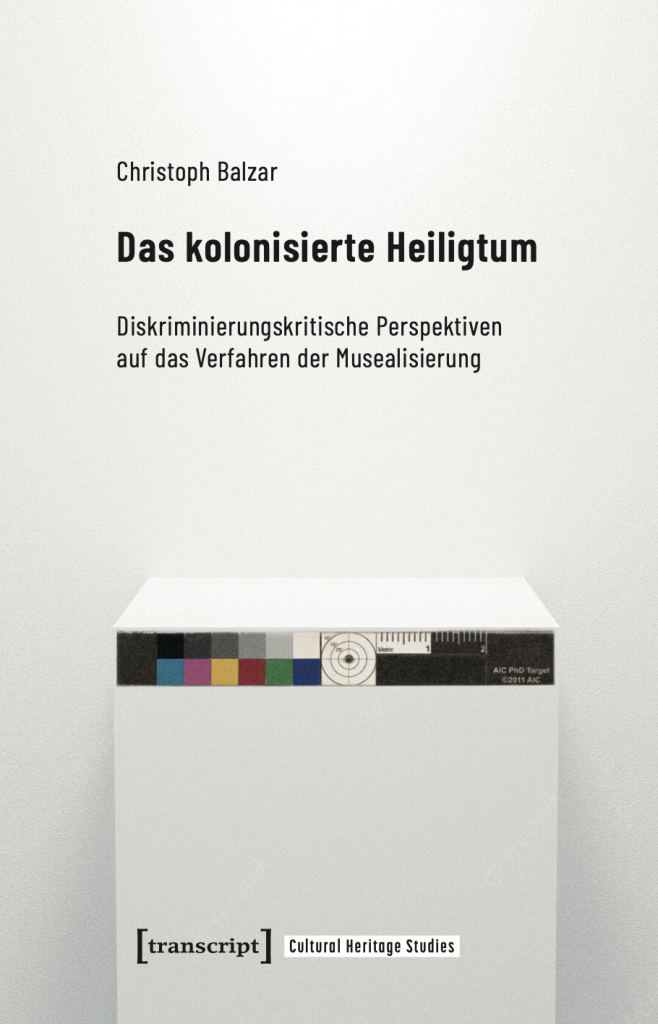
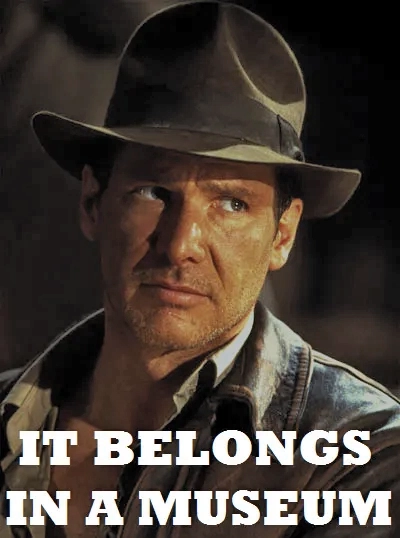
„Es ist bekannt geworden, daß eine Bauersfrau ihre gelegentlichen Stadtgänge dazu nutzte, ins Museum zu gehen und vor einem Marienbild eine kurze Andacht zu verrichten. Die Frau hatte, wie sie später erklärte, zu dieser Maria seit ihrer Kindheit gebetet. Damals stand die Skulptur in der Kirche ihres Heimatortes; später kam sie ins Museum. Eine Zeitlang beobachteten die Museumsleute das Tun der Frau ziemlich hilflos; dann entschieden sie sich, Andachten im Museum nicht zuzulassen. Die Frau wurde abgewiesen. Beten verboten!“
As a member of the activist group "Between Memories and Possibilities" I work with representatives of the Kogi people from Columbia, the traditional owners of the famous Tairona gold artefacts. Most of their holy relics were taken from their sacred sites in the middle of the 20th century and sold to museums and private collections all over the world. To the Kogi people the theft of those artefacts means nothing less than the loss of their gods.
The Museo del Oro, Bogotà, the Louvre, Paris, the Metropolitan Museum, New York and many other western institutions present such artefacts like mere art objects: separated, isolated and installed. We have to look at such exhibits critically and question the compatibility of their original cultural meaning and their formal aesthetic presentation.
Together with philosopher Hanune Shalati I work on a program that aims to extract Tairona gold artefacts from the art context by motivating art collectors through art to purchase and donate such relics to our organisation Culture & Development e.V.. We then return them to the Kogi. Such donations are more than just gestures of good will: they are the foundation for our intercultural endeavors of artistic, philosophical and ethnological research.
Many of the records, photographs and images in modern Australian society include depictions of Aboriginal and Torres Strait Islander peoples, culture and experience. Such media may also include sensitive material that may require certain restrictions on access for spiritual reasons. In relation to Aboriginal and Torres Strait Islander content these sensitivities have greatest force when the materials include records and/or depictions of secret and/or sacred information which may have been recorded with or without permission. There are both published and archival materials which contain secret or sacred material which should have not be made generally available.
An item may not be on open access to everyone. A sacred site may have to stay secret to only an initiated few elders. One clan may consist of different totemic groups, all of them restricted to only their own images, songs, rituals and artefacts. Furthermore, each clan and group is separated into women's and men's business thus creating a complex system of restrictions and privileges.
These cultural protocols often clash with modern ideals of availability and accessibility. European hegemony continous its colonial force within the mass media.
Art spaces and museums have been considering for years their methods of presentation as a reflection of their own ideals, interests and aims. Today, an ever-growing movement of curators, ethnographers and related artists see a vital importance for ethnological museums to put themselves into their equations of their research and their presentations. They understand them as producers of meaning, following political ideologies and social interests.
"Ethnographic objects are objects of ethnography. They are artifacts created by ethnographers when they define, segment, detach, and carry them away. Such fragments become ethnographic objects by virtue of the manner in which they have been detached. They are what they are by virtue of the disciplines that "know" them, for disciplines make their objects and in the process make themselves. For this reason, exhibitions, whether of objects or people, display the artifacts of our disciplines. They are also exhibits of those who make them."
Barbara Kirshenblatt-Gimblett, Destination Culture: Tourism, Museums, and Heritage
(University of California Press, 1998)
"There is information that is restricted, that our children cannot learn about, there is information that is restricted even to adults, there is information that is of a secret or sacred nature, that many people have no knowledge of or access to. That knowledge is only there for certain people to have access to."
the protocol archive
2009; vinyl lettering on MDF-boards;
dimensions variable; edition 1/3 + 2AP
cultural warnings from the Australian mass media;
further reading HERE
You’re damned if you do and you’re damned if you don’t.
My research on indigenous Australian culture and its religious protocols stems back to an earlier works titled „uluru“. It was an attempt to grasp the complexities of the famous tourist site “Ayer’s Rock” that is in the eyes of the Aboriginal Australians a sacred site and taboo for not initiated people. It caught my attention that one of the last traditionally living Aboriginal persons from that area had visited the nearby Alice Springs in the 1970ies where he encountered an image of “uluru” in an ad of the tourist industry. He committed ritual suicide by spearing himself because he was bound to the “tjukurrpa”, the law and not allowed to see it. I learned that it causes enormous grieve to the indigenous communities who still live by these laws to see today’s society often ignore their ancient traditions and taboos.
Nevertheless, a growing part of Australian society tries to understand the complex issue of Aboriginal protocols. Various governmental and private, indigenous organisations give advice:
„Many of the records, photographs and images in modern Australian society include depictions of Aboriginal and Torres Strait Islander peoples, culture and experience. Such media may also include sensitive material that may require certain restrictions on access for spiritual reasons. In relation to Aboriginal and Torres Strait Islander content these sensitivities have greatest force when the materials include records and/or depictions of secret and/or sacred information which may have been recorded with or without permission. There are both published and archival materials which contain secret or sacred material which should have not be made generally available. An item may not be on open access to everyone. A sacred site may have to stay secret to only an initiated few elders. One clan may consist of different totemic groups, all of them restricted to only their own images, songs, rituals and artefacts. Furthermore, each clan and group is separated into women‘s and men‘s business thus creating a complex system of restrictions and privileges.“
summary of the “Aboroginal and Torres Strait Islander Library and Information Resources Network Protocols“
One of the most peculiar concepts to do indigenous protocols justice is when culturally sensitive material such as images of deceased persons is published in the mass media. Such cases could be news reports of accidents, historical documents but also movies in which indigenous actors perform (they will die one day, too and from that day on the movie will show a deceased person). In most cases when such images are being broadcast by the Australian media, one can find notifications at the beginning of the screening that address the indigenous population and warn of various forms of culturally sensitive material.
Aboriginal and Torres Strait Islander viewers should exercise caution when watching this movie as it may contain images and voices of deceased persons.
There are many different versions of this message, some longer, more detailed or specific than others. They can be found on television, in movies, in books, on websites, learning material (i.e. CD-roms), etc. The idea is of course politically motivated. You don’t want to harm Aboriginal people by showing something they don’t want to see for spiritual reasons. But does it work this way? On the internet with its system of hyperlinks that one follows individually it might make sense to put such “stop signs”. But what if somebody tunes in on the news a little bit too late, misses the warning and catches a glimpse of a deceased clan member? It appears that those notifications are not the ultimate solution but that they might even have the opposite effect. It just becomes too easy to show things that are taboo by simply putting a readymade warning message up in front. I began to collect those notifications in “the protocol archive” in an attempt to research their context and their effects on the indigenous and non-indigenous communities. Their design for the media made it obvious to introduce them to another format that „shows“: the museum.
Living in Berlin the Ethnological Museum Dahlem has become one of my main points of interest in its cultural landscape. When I first visited the permanent exhibition of Australia I was shocked to see the same indigenous laws violated even there. There are many artefacts of Aboriginal people on display (especially of the Arrernte tribe) that are known as “tjuringa” or “secret-sacred”. Some of them are powerful, magical curses, others are regarded as the twin souls of the tribe members, both living and deceased. They are a clans connection to its ancestors and the land on which they used to live. In today’s Australian society it is unthinkable to present such objects in a museum space; the political pressure from the Aboriginal councils has even lead to a mass return of secret-sacred objects to their original nations. It surprised me that even despite the Australian embassy has filed several complaints about this sacrilegious form of presentation in the past only “most of the tjuringa” were taken off display and brought to the store in the basement whilst some are still being shown.
I decided to restage Dahlem’s exhibition of Arrernte artefacts at the „Museumslabor Dahlem“. In the appearance of a live-webcam video with time and location codes programmed on top, the particular vitrine was presented as a projection at homebase projects during ART FORUM BERLIN 2010. „The protocol archive“ was one of the mixed-media installations to highlight the complexities of Aboriginal image prohibitions that were violated in that vitrine. People were invited to put the said warning messages, printed on wooden boards, to the test and to block those parts of the projection where „tjuringa“ could be seen. Nevertheless, the visitors realized that they could not „un-see“ them.
The “Museumslabor Dahlem” was accompanied by an artistic research about the provenance of those exhibits, all belonging to the “Wettengel Collection”. The collector Nikolaus Wettengel was a German missionary for the Lutheran church who lived in Australia and converted Aboriginal children in Hermannsburg between 1896 and 1906. The publication “Die Sammlung Wettengel” is a chronological reconstruction of his correspondence with the church and indicates that he has plundered a secret-sacred cave where those “tjuringa” were hidden before he sold them to the “Völkerkundemuseum Berlin”. One might ask why those “tjuringa” are not simply returned to the Arrernte nation in Central Australia. It turns out that their restitution to their traditional owners also clashes with indigenous protocols. It appears that within the communities nobody would even dare to accept, let alone look at them if they were ever returned. It isn’t clear to which totemic clan they belong and no Aboriginal person wants to risk breaking a sacred taboo by looking at another clan’s “tjuringa”.
So what should be done with them?
Das Museumslabor Dahlem
In der Debatte um das Humboldt-Forum wurde bislang meist über den Symbolcharakter der Berliner Schlossfassade diskutiert, weniger jedoch über die konzeptuellen Herausforderungen, denen sich ein ethnologisches Museum heute stellen muss. Es sind vor allem die in kolonialen Zeiten gewaltsam akquirierten Sammlungsbestände des preußischen Kulturbesitzes, welche das Bauvorhaben dieses Universalmuseums schon im Vorfeld zu belasten schienen. Welchen Themen wird man sich beim Transfer der Kulturgüter vom Ethnologischen Museum Dahlem ins Humboldt-Forum demnach stellen müssen?
Im Rahmen des diesjährigen HOMEBASE PROJECT’s, welches zum ersten Mal von New York nach Berlin kommt, installiert der Berliner Künstler Christoph Balzar zu dieser Problematik das Museumslabor Dahlem. Darin präsentiert er eine zweijährige Recherche über sakrale Artefakte zentralaustralischer Aborigines im hiesigen Ethnologischen Museum. Der Schwerpunkt seiner Nachforschungen liegt dabei auf religiösen Bildverboten des Stammes der Aranda, dem nur für die Augen initiierter Stammesmitglieder bestimmten “secret-sacred business”, wozu auch einige der in Dahlem gezeigten Artefakte gehören. Deren öffentliche Präsentation ist insofern problematisch, als dass sie dem Kern dieser auf Geheimnissen gebauten Kultur fundamental widerspricht.
Neben einer künstlerischen Recherche über die Beschaffungswege dieser Objekte versteht sich das Museumslabor Dahlem auch als Forum zu Themen der Präsentation, Repräsentation und Repatriation. Es stellt sich in Zeiten vermehrter Rückgabeforderungen durch traditionelle Eigentümer die Frage, welche Chancen gerade für ethnologische und anthropologische Museen im Schulterschluss mit Künstlerinnen und Künstlern liegen.